Why context is everything in AI for small businesses
 Rami Sgaier, CTO·Mar 11, 2026
Context is what separates AI that genuinely helps from AI that just makes things. Generating a caption or an image takes seconds now, so producing content is no longer the hard part of social media. The hard part is whether the AI understands your business, your voice, and the moment you are in. That understanding is the whole difference.
Making content stopped being the problem
For most of my career as an engineer, the bottleneck was output: writing enough, designing enough, shipping enough. That bottleneck is mostly gone. In HubSpot's 2026 survey, 83.5% of marketers said they are now expected to produce more content because AI makes it so easy. A tool will hand you a caption, three post ideas, and an image before you finish your coffee. Volume is a solved problem.
Which means the thing that used to set a small business apart, simply showing up with enough content, no longer does on its own. Everyone has the same firehose now. When the cost of making a post drops to almost nothing, the post itself stops being the valuable part.
Why context matters more than ever
Context is what turns generic output into something worth posting. Without it, AI produces words and images that could belong to any business. With it, the same model produces something that could only be yours. The model is identical for everyone; what you feed it is not.
The examples are easy to picture. A gym should not sound like a law firm. A travel agency's visuals should not look like a dental clinic's. A business launching a new service needs different content from one trying to win back old customers. A model knows none of that on its own. Someone, or something, has to tell it.
And people feel it when that is missing. McKinsey found that 71% of consumers expect companies to deliver personalized interactions, and 76% get frustrated when that does not happen. Generic content does not land as neutral. It lands as "this was not made for me," and people quietly scroll past.
What context actually means for a small business
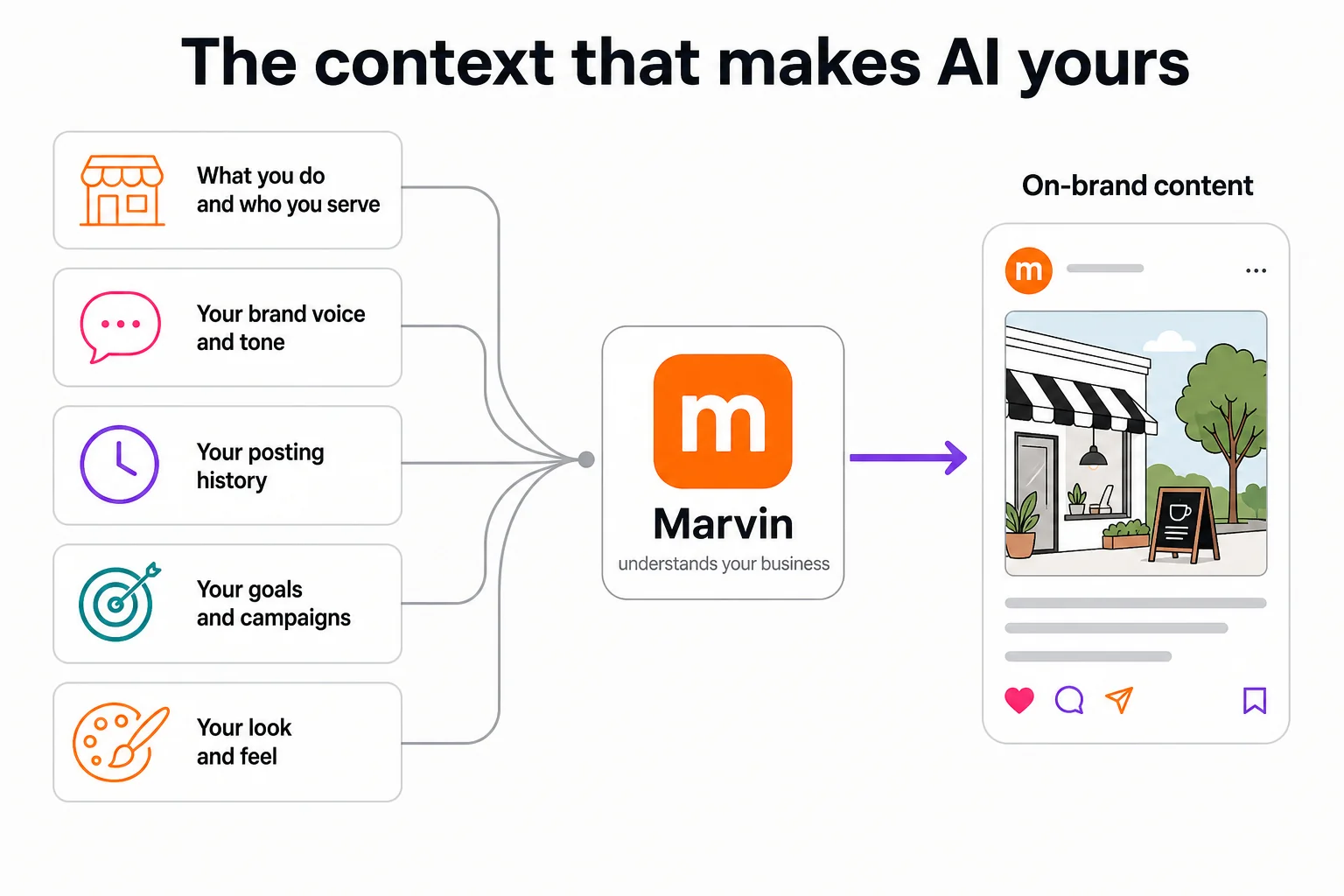
For a small business, context is a specific set of things an AI needs to know about you: what you do and who you serve, your brand voice and tone, your posting history and what has worked, your current goals and campaigns, and the look and feel that makes you recognizable. It is not a buzzword, it is a checklist.
When a tool actually holds all of that, the day-to-day changes. No more generic, off-the-shelf results. No more re-explaining your business in every prompt. No more starting from a blank page each time you want to post. That last one matters most, because small business owners are already doing ten jobs at once. They do not have the time to brief a tool from scratch every morning, and they should not have to.
The future is not better prompting
The next step for AI in marketing is not teaching business owners to write cleverer prompts. It is building AI that already knows enough about your business to help without being briefed every time. The work should sit with the software, not with the owner.
That is the bet we made when we built Marvin, and as the person responsible for how it works under the hood, it is the part I care about most. It would have been quicker to ship one more tool that takes a prompt and returns a post. We took the harder path: an AI that remembers your brand and audience, adapts to your goals and tone, stays aligned as your brand changes, and gets more useful the more you use it.
The payoff is not only nicer posts. HubSpot's 2026 data shows 62.7% of marketers now say they need more unique, human-centered content to compete with AI content, and 93.2% report that personalized content drove more leads and purchases. As one of their marketing leaders put it, people want "content that feels like them." Context is how a small team gets there without raw AI flattening everyone into the same beige voice.
Content that knows who you are
So here is the takeaway I would give any small business owner weighing up AI: the goal is not more output, you already have plenty of that. The goal is the right output, made with real understanding of your business. When the AI knows who you are, it stops being a tool you operate and starts being closer to a teammate who already gets it. That is what we are building Marvin to be. If you want to see what on-brand content with your context built in looks like, that is what Marvin does.
Frequently asked
- Why isn't generating content with AI enough on its own?
- Because generation is now the easy part. Any tool can produce a caption or image in seconds, so volume no longer sets you apart. What makes content work is context: the AI knowing your business, voice, and goals. Without that, you get output that could belong to anyone.
- What does context mean for a small business using AI?
- It is what the AI knows about you: what you do and who you serve, your brand voice and tone, your posting history, your current goals, and your visual style. With those in place, the AI stops giving generic results and stops making you re-explain your business every time.
- Does generic AI content actually hurt my business?
- It can. McKinsey found 76% of consumers get frustrated when interactions do not feel personalized, and most marketers now say they need more unique, human content to stand out. Generic content reads as not meant for the reader, so people tune it out.
- How does Marvin use my business context?
- Marvin learns your brand, audience, voice, and goals once, then applies them to everything it creates. It remembers what you have posted, stays aligned as your brand changes, and improves the more you use it, so you get on-brand content without briefing it from scratch each time.