Why AI content all sounds the same (and how to fix it)
 Sharbel Safyi, CEO·Mar 24, 2026
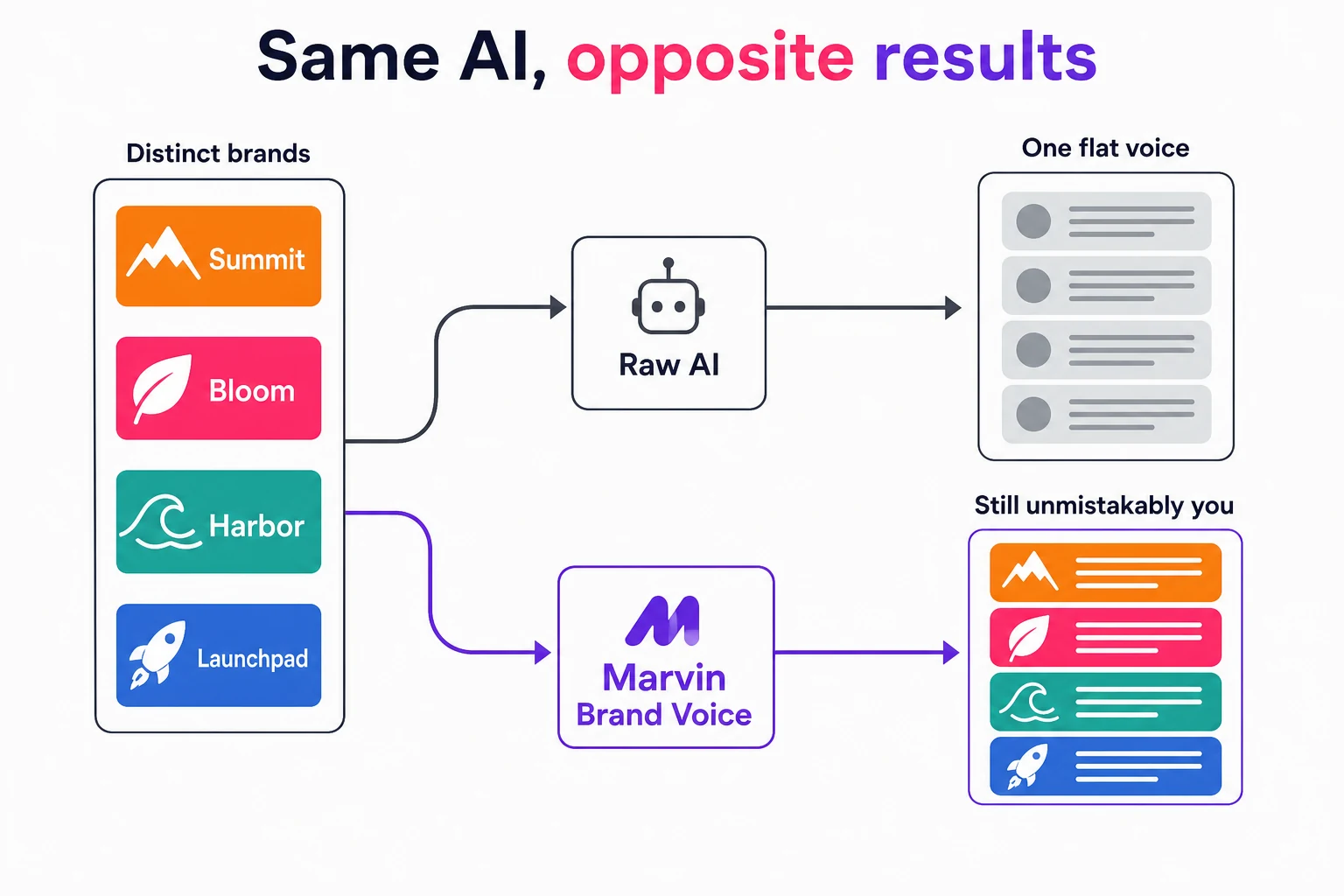
Why does so much AI content sound the same? Because most people stop at the raw output. The same handful of models now write for millions of businesses, so straight out of the box they hand everyone the same flat, average voice. We built Marvin on the opposite bet: use the AI, then do the work that makes you sound like no one else.
We spent years doing this for big brands only
For years, my work was marketing for large companies, the kind with national reach and budgets to match. We were good at it, and we were always full. So when a small shop or a solo founder came asking for help, the honest answer was usually no. Not because they didn't deserve a real voice, but because we couldn't give it to them one at a time.
That always sat wrong with me. A corner bakery, an indie software maker, a new skincare line: every one of them has something worth telling the world, a reason to exist, products that deserve to sell. The thing they were missing wasn't talent. It was access. The marketing machinery big brands take for granted was priced and staffed out of reach. Marvin started as the fix: take what we did for the large accounts and make it cheap, simple, and open to anyone.
The trap isn't using AI. It's stopping at raw AI.
Here is the part people get wrong. The problem with AI content isn't that a machine helped write it. It's that everyone is now feeding the same few models the same kinds of prompts and publishing whatever comes back. In April 2025, Ahrefs analyzed 900,000 new web pages and found 74% already contained AI-generated content, and in its survey of marketers, 87% said they use AI to write or assist. The tools aren't a secret advantage anymore. They're table stakes.
When the tool and the prompt are identical across millions of businesses, the output converges. You don't end up sounding robotic. You end up sounding like everyone. If raw model output is all you publish, you're putting out the same beige voice as the competitor down the street, because you're both using the same machine the same way. The same convergence is now coming for visuals, as image generation gets built into the tools everyone already uses.
Your tone is a fingerprint
A brand's tone is closer to a fingerprint than a setting. The way you phrase a promise, the jokes you'll make and the ones you won't, the words you'd never be caught using: together they're a pattern that should belong to you and nobody else. The rule we hold Marvin to is blunt. No two businesses should come out of it sounding the same.
And people feel the difference even when they can't name it. In a study of 2,000 consumers, Bynder found that 52% disengage the moment they suspect copy was written by AI, and about a quarter said brands with AI-sounding website copy came across as impersonal. A generic voice doesn't just blend in. It quietly pushes people away.
So we say yes to AI, then keep going
This is why Marvin runs on the same large models you've heard of, the GPTs and Geminis of the world, and then refuses to stop there. The model is the raw material, not the finished piece. The real product is everything that happens after: capturing how your brand actually sounds, then shaping every draft through it until what you publish reads like you wrote it on a good day.
We built a whole feature around that single step. Brand Voice learns your tone once, from the way you already talk, then holds every post to it across every channel. You teach it who you are, and it keeps the AI from flattening that back into the default. It's the same discipline we used on the big accounts, done by software instead of a room full of people, so the price finally fits a business of one.
What this means for you
If you take one thing from this, make it this: never ship raw AI as-is. Use it for the speed, then put your fingerprint back on top, your stories, your phrasing, the specific way you'd say it to a regular. That last step is the whole game. It also pays off where it counts: when Semrush analyzed 42,000 blog posts, human-written content held Google's number-one spot 80% of the time, against 9% for purely AI-generated pages. Sounding like a real person isn't only good taste. It's what still wins. And the same trap exists for pictures: AI-generated images drift generic exactly like AI copy does, and the fix is the same discipline.
We built an AI marketing tool because everyone deserves to show up consistently, without a big team or a big budget. We fight to keep it human because showing up only works if it sounds like you. Both are true at once, and that tension is the product. If you want to see what it looks like in practice, that's what Marvin does.
Frequently asked
- Does AI-generated content all sound the same?
- Used raw, largely yes. The same few models now write for much of the web, so unedited output drifts toward one flat, average voice. The fix isn't avoiding AI. It's adding your own tone, examples, and phrasing on top, so the published piece sounds like you and not the machine.
- Is it bad for SEO if my content sounds AI-generated?
- It can be. Human-written content holds Google's top spot far more often than purely AI pages, and readers disengage when copy feels machine-made. Treat AI as a starting point, then edit it into something genuinely human before you publish.
- If Marvin uses AI, how is its content any different?
- Because the model is only the first step. Marvin captures your brand's tone, runs every draft through it, and adapts it per channel, so the result sounds like your business specifically. Raw AI gives everyone the same voice; Marvin's job is to give you back yours.
- How does Marvin keep my content sounding human?
- It learns your voice once through Brand Voice, from how you already talk, then holds every post to that tone everywhere you publish. You stay recognizable across channels without having to rewrite anything yourself.