Why marketing doesn't translate across cultures
 Sharbel Safyi, CEO·May 14, 2026
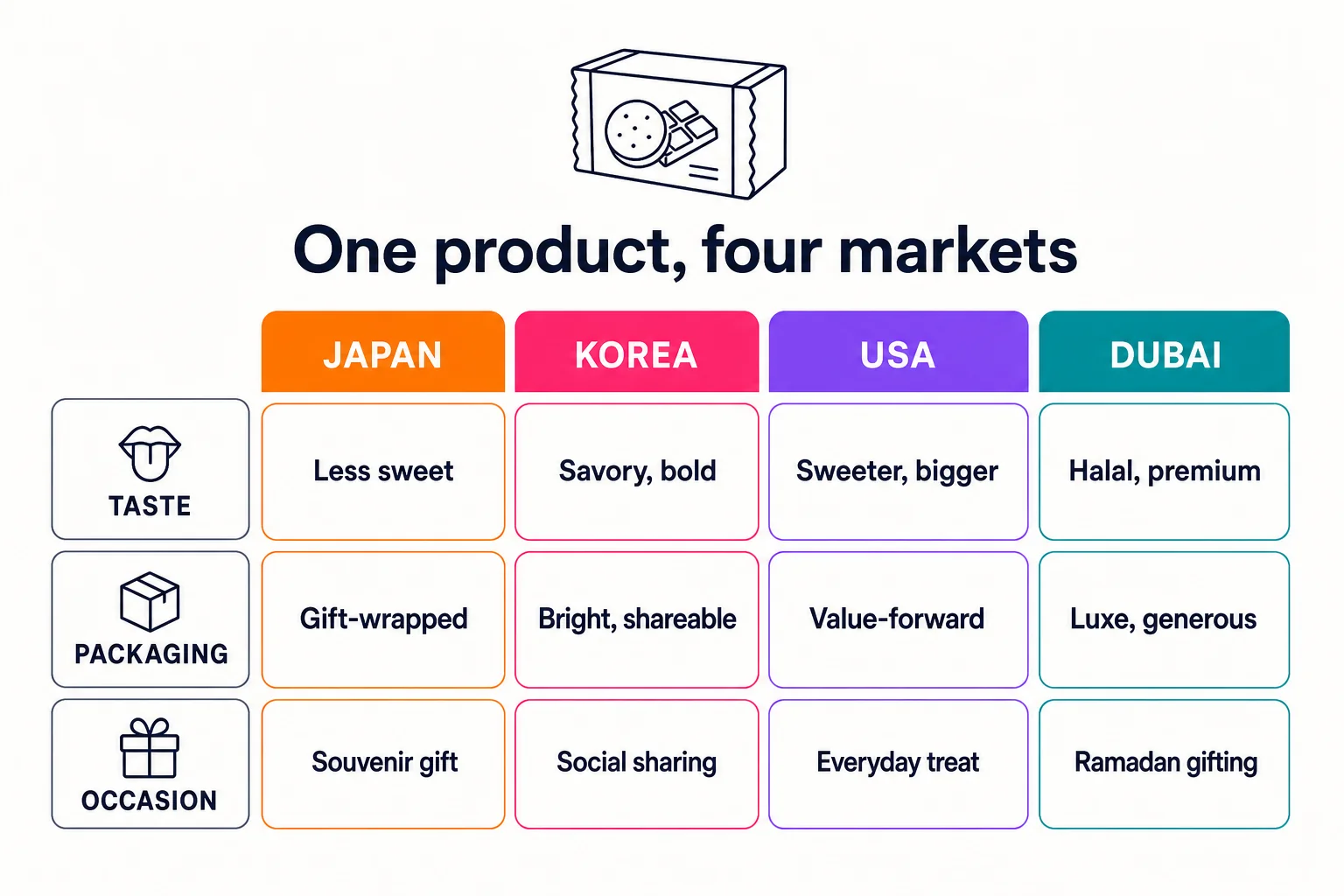
Marketing does not translate across cultures, because taste, packaging, and what people actually value are not universal. The same product gets made less sweet for Tokyo and sweeter for Dallas, wrapped plainly in one country and as a gift in another, sold as an everyday snack in one market and a Ramadan ritual in the next. I learned this running marketing across regions, and it is the rule, not the exception.
A product is a different product in every market
The clearest place to see it is food, where the recipe itself changes at the border. When Oreo launched in China in 1996 as the American cookie, it nearly failed: people found it too sweet and the packs too big. Kraft cut the sugar, shrank the packaging, and added flavors like lemon, and sales rose 80% in some regions and tripled in others.
Menus bend the same way. McDonald's serves no beef or pork in India, out of respect for Hindu and Muslim beliefs, and built the McAloo Tikki around a spiced potato patty instead. The Gulf gets the McArabia in flatbread, and South Korea gets a Bulgogi Burger in a local marinade. One golden-arches brand, a different plate in each country.
In Japan, the wrapping can matter as much as what is inside
In Japan, packaging is not just a container, it is part of the gift. The culture of omiyage, the regional souvenir you bring back for colleagues and family, makes presentation carry real meaning, and brands lean into it hard. Nestle has sold more than 300 regional and seasonal Kit Kat flavors in Japan since 2004, many tied to a specific prefecture, because it found that limited, local editions create what the company calls a "scarcity and rarity of value." The wrapper, and the place it is from, are doing as much selling as the chocolate.
The calendar and the occasion change too
When and why people buy shifts just as much. In Japan, fried chicken is a Christmas meal: KFC has run its "Kentucky for Christmas" campaign since 1974, and the days around Christmas have brought in close to a tenth of its yearly sales there. In the Gulf, the year bends around Ramadan instead, when spending climbs and gifting peaks; UAE Ramadan retail spend was estimated at around 10 billion dollars in 2025. Sell the same product against the wrong occasion and you are invisible.
You cannot copy and paste a brand across borders
Put it together and the lesson is blunt: a brand does not survive being copied and pasted into a new market. When I helped run marketing for a global company, we built the strategy at headquarters and handed it to regional teams, each with its own market, language, and pace, and the campaigns that worked were always the ones we let each team reshape. The instinct to ship one global version is expensive. In a survey of 8,709 consumers across 29 countries, CSA Research found that 76% prefer to buy in their own language and 40% will not buy from sites in another language at all. Language is only the most measurable part. Taste, packaging, humor, and the occasion you sell against all move with it.
In the AI era, that adaptation is finally affordable
Here is what has changed. Until recently, adapting a brand for every market meant a room full of people in every region, which is exactly why only the big companies did it. AI changes the math. A system can now learn how your brand sounds and looks, then bend it to a new language, culture, and style without starting over each time. That reach is suddenly open to a business of one.
The catch is the same one we keep coming back to: raw AI flattens everything into one average voice, and a flat translation is just another way to sound like no one. The work is a system that holds your brand steady while it adapts the surface to each audience. That is what Brand Voice is built to do: capture how you actually sound once, then keep you recognizable everywhere you show up.
So if you want what you make to speak internationally, and AI is finally making that possible, do not build a hundred separate campaigns. Build one system that keeps your brand intact and adapts it to each culture, language, and style. That is what Marvin does.
Frequently asked
- Why doesn't the same marketing work in every country?
- Because taste, packaging, language, and the occasions people buy for are not universal. The same product is often made sweeter or less sweet, wrapped differently, and sold against a different holiday from one market to the next. Marketing that ignores those differences reads as foreign, and people quietly tune it out.
- How do global brands adapt their products to local tastes?
- They reformulate and repackage instead of shipping one version. Oreo was made less sweet with smaller packs for China, McDonald's drops beef and pork in India, and Nestle sells hundreds of regional Kit Kat flavors in Japan. The brand stays recognizable while the recipe, size, and packaging change to fit local preference.
- Why is packaging so important in markets like Japan?
- In Japan, presentation is part of the gift. The omiyage tradition of bringing back regional souvenirs makes how something is wrapped carry real meaning, so beautiful, local, limited-edition packaging signals care and value. For many products there, the wrapper does as much selling as what is inside.
- Can AI help a small business market across cultures?
- Yes, and that is the shift. Adapting a brand to each market used to need regional teams only big companies could afford. A system that captures how your brand sounds and looks, then adapts it to a new language and culture, puts that reach within range of a business of one, as long as it keeps you sounding like yourself and not like generic translation.