Marketing materials every small business needs
 Sharbel Safyi, CEO·Jul 27, 2026
Every business needs a small, consistent set of marketing materials to look professional online and offline. A basic kit is a business card, a one-pager, a roll-up banner, a social post, and a short presentation deck. What matters most is not any single piece, it is that they all look like the same brand. This is how one real business, GummyGrow, built its whole kit on brand in about thirty minutes, and what each piece is for.
The basic marketing kit every business needs
Marketing materials are the branded pieces a business uses to present itself, the things a customer or partner sees before, during, and after they decide to work with you. Most businesses need the same small core set, whatever the industry.
A business card is still the fastest way to hand over your details in person. A one-pager explains what you do on a single sheet, useful in sales and partnership conversations. A roll-up banner gives you a professional presence at an event, a market, or a storefront. A social post keeps you visible online, where most people meet a brand first. And a short presentation deck carries you through a pitch or a proposal. Add an email signature and branded letterhead, and you have covered almost every place a business shows up.
Why the whole set matters, not just one piece
Looking professional is not vanity, it is credibility, and credibility is measurable. In a Stanford study of how people decide whether to trust a website, the way it looked was the single most-mentioned reason people gave for trusting or distrusting it. The same snap judgment happens offline, across a table, when someone glances at your card or your deck.
Consistency is where the money is. Lucidpress found that consistent brand presentation can lift revenue by up to 33%, because a brand that looks the same everywhere reads as established and dependable. A business that shows up with a sharp card, a matching deck, and a consistent social feed earns trust at the moment a customer or partner is deciding. A business with a mismatched set, or missing pieces, quietly loses it, and usually never finds out why. Keeping the look consistent across everything you make is the part that pays off over time.
The hard part is making them match
Making one business card is easy. Making a business card, a one-pager, a deck, a banner, and a social post that all look like one brand is the hard part, and it is ongoing, because the set has to change as the business grows.
That upkeep is a core part of what agencies and designers sell, and it is not cheap. In WebFX's 2026 survey of over 1,000 U.S. businesses, agency retainers run from $1,000 to $12,000 a month. Yet in LocaliQ's 2026 small-business report, 52% of small businesses have a total marketing budget under $1,000 a month, and half have no employee dedicated to marketing at all. The result is predictable: most owners drop their logo into a different free template for each piece, and nothing matches. There is a fuller comparison of the tool-versus-agency math if that is the decision you are weighing.
The way out is to define the brand once, then apply it to everything. Here is what that looks like for a real business.
Meet GummyGrow, a real kit built in about 30 minutes
GummyGrow, a small brand that makes fruity gummy-bear multivitamins for kids, needed all of it: cards for meetings, a one-pager and a deck for retail partnerships, a banner for events, and posts for social. Here is the whole kit, built start to finish with Marvin, a marketing tool that learns a brand once and creates on-brand content from it.
Making marketing materials without a designer starts with your brand
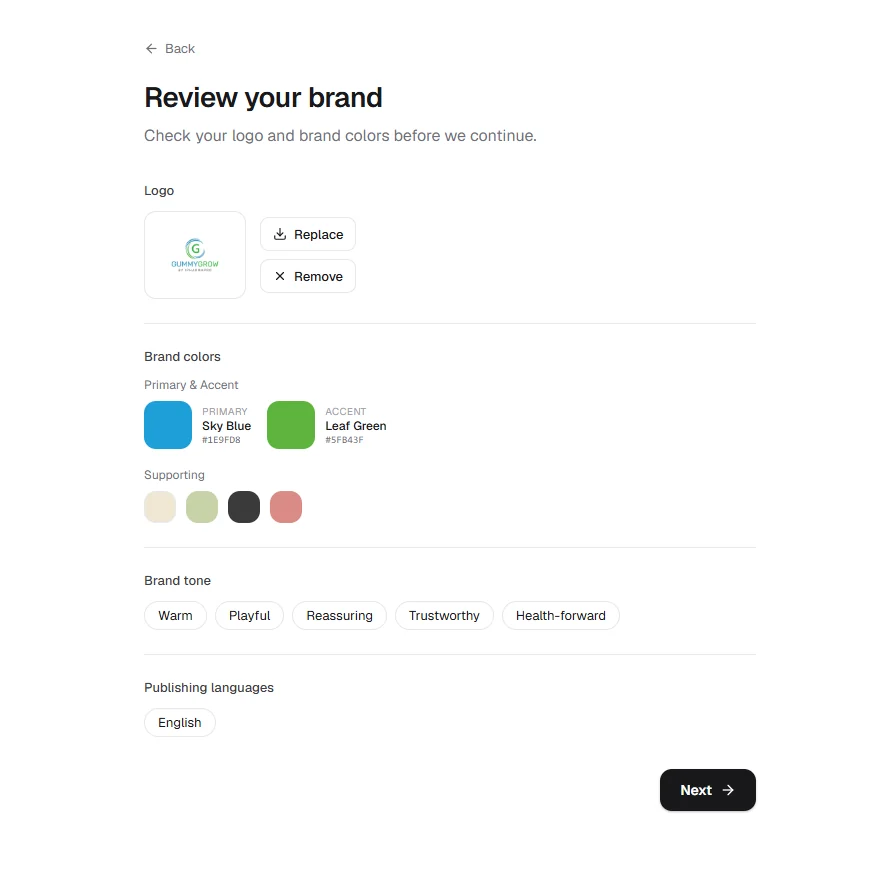
Marvin does not begin with a blank canvas. Onboarding asks for the business website and reads it, pulling the logo, colours, fonts, and voice into a brand kit, then showing them back for a quick review. GummyGrow's site gave Marvin its blue and green, its logo, and its warm, playful tone in a couple of minutes, and every asset it makes from here inherits that automatically.
Shape the piece, let Marvin design it
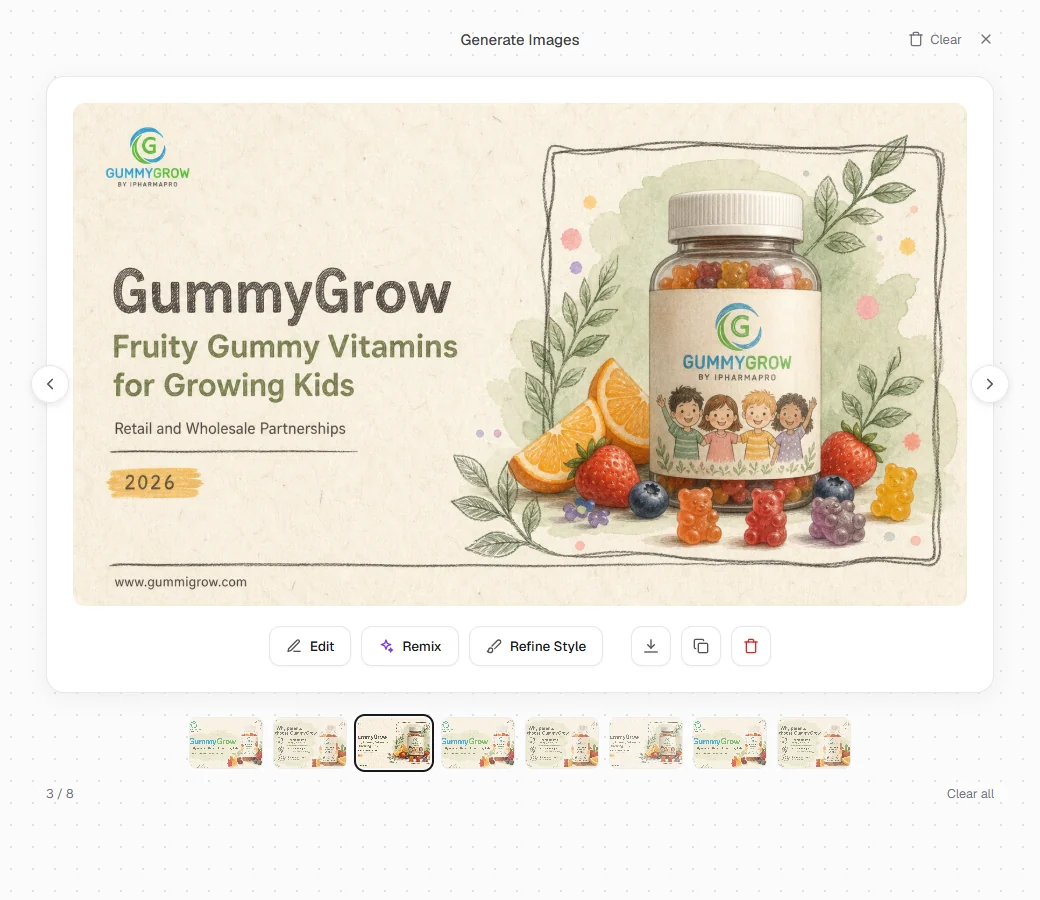
Every asset is made in Studio. Instead of starting from scratch, you press Help me shape it and describe the piece in plain words. For GummyGrow's title slide, that was a large title, GummyGrow, a tagline, Fruity gummy vitamins for growing kids, and a small line, Retail and wholesale partnerships. Marvin writes that exact text onto the image and keeps the logo in place.
For the visual behind the words, you can press Surprise me and Marvin proposes a scene. For the slide it suggested a bottle of gummies with fresh fruit on a cream background with hand-drawn botanical accents, on brand without any art direction. Then you choose the ratio and how many variations you want, and Marvin generates a set to pick from.
One tool, every shape: business card, one-pager, banner, social post
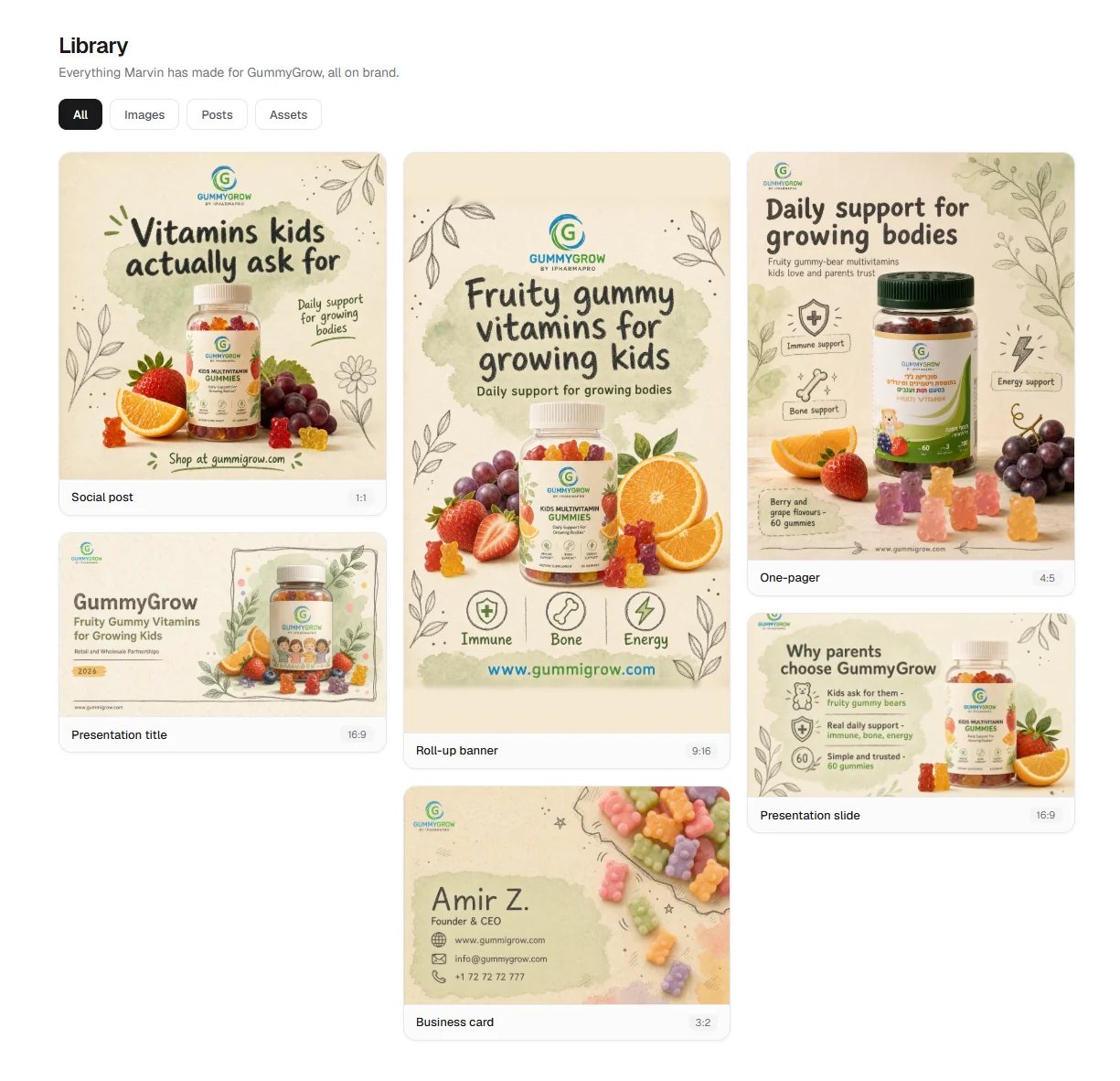
One tool covers the whole kit because you change the ratio to fit the piece. GummyGrow made its business card at 3:2, its one-pager at 4:5, its roll-up banner at the tall 9:16, its social post at square 1:1, and its presentation slides at 16:9. Same brand kit, same few steps, a different shape each time. The same tool also creates and publishes on-brand posts day to day, so the kit and the everyday content come from one system.
The finished kit, one brand
Because every piece came from the same brand kit, they come out as a set, not a pile of unrelated files. The logo, colours, and type are identical across all of them without any extra effort. GummyGrow's whole kit lives together in the Library, on brand from the card to the banner.
An on-brand presentation deck, without a designer
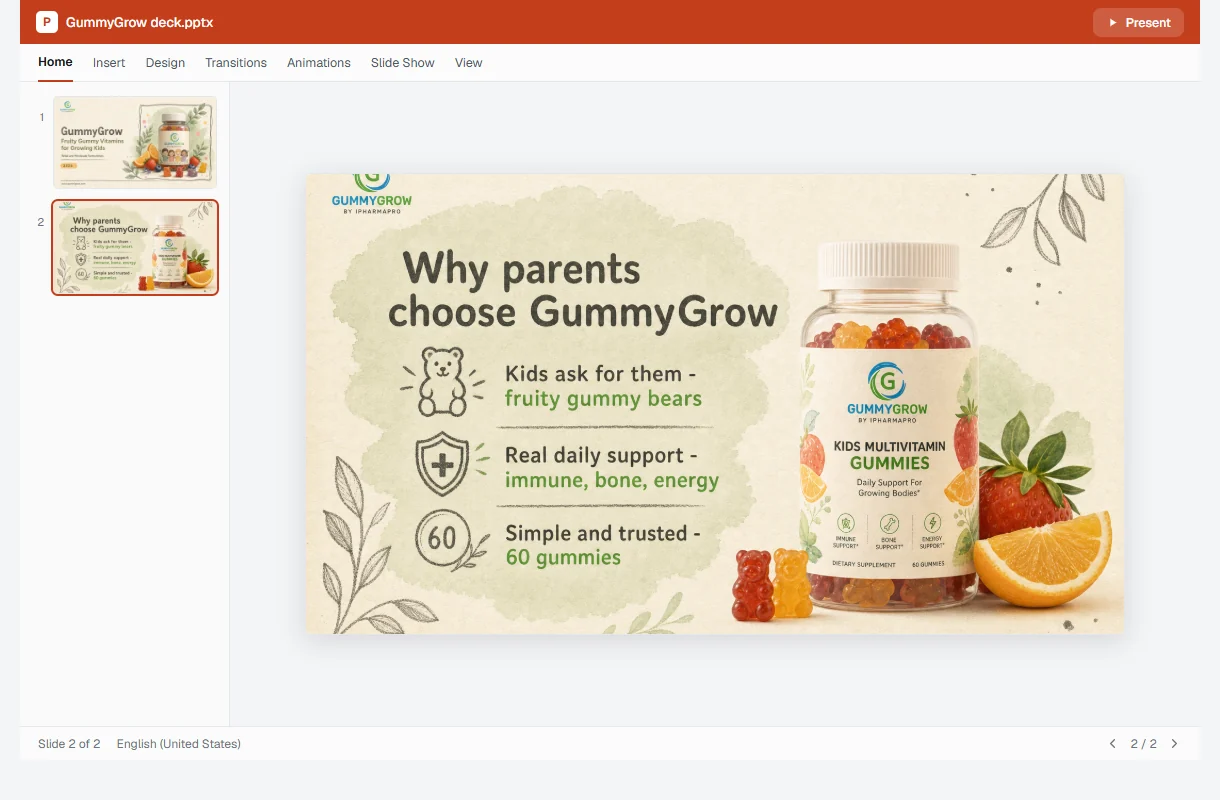
The presentation is the same story. The slides GummyGrow generated drop straight into a deck, on brand from the title slide to the last point, ready to show a retail buyer without a designer touching it.
One kit, kept in sync
The real advantage shows up later. When the brand changes, a new colour, a refreshed logo, a different tagline, the kit is not five separate redesigns. The brand kit updates, and the next assets follow it. A business that grows does not outgrow its materials, it regenerates them. That ongoing upkeep, the part an agency bills for month after month, becomes a few minutes in Studio, and what a Marvin plan includes is built for a business of one.
GummyGrow's founder puts the wider experience simply: "I grew my side business without learning marketing. Marvin keeps getting better on its own." (Amir Zaher, CEO)
A consistent set of marketing materials is one of the cheapest ways to look established, and one of the most overlooked. The pieces are easy to name; the hard part has always been making them match and keeping them that way as the business grows. Marvin builds the whole kit from one brand system and keeps it in sync, so a business can look the part everywhere, online and offline, without a designer on call.
Frequently asked
- What marketing materials does a small business actually need?
- A small core set covers most situations: a business card and a one-pager for in-person and sales conversations, a roll-up banner for events, a social post for your online feed, and a short presentation deck for pitches. An email signature and branded letterhead round it out. The exact list matters less than keeping every piece on the same brand.
- Can I create these without a designer?
- Yes. Tools like Marvin generate branded assets from a brand kit, so you describe the piece in plain words and the layout, colours, fonts, and logo are applied for you. You still decide what each piece says; the design work is handled.
- How do I keep all my marketing materials on brand?
- Define the brand once, in one place, and generate every asset from it rather than rebuilding each in a separate template. When the source is a single brand kit, a business card, a deck, and a banner come out matching by default, and updating the kit updates what you make next.
- How long does it take to make a full kit?
- With the brand already captured, each asset is a short description and a ratio choice, so a full core set, card, one-pager, banner, social post, and deck, can be produced in about half an hour. The first-time setup, onboarding the brand from a website, adds only a couple of minutes.