AI marketing tools vs hiring an agency for a small business
 The Marvin Team, Content & Growth·Jul 20, 2026
For most small businesses, an AI marketing tool now covers the everyday work an agency retainer used to buy, the planning, writing, design, and publishing, at a small fraction of the cost. A marketing agency still earns its fee for complex paid campaigns and strategy-heavy launches. Which one fits comes down to budget, scope, and time.
What a marketing agency costs in 2026
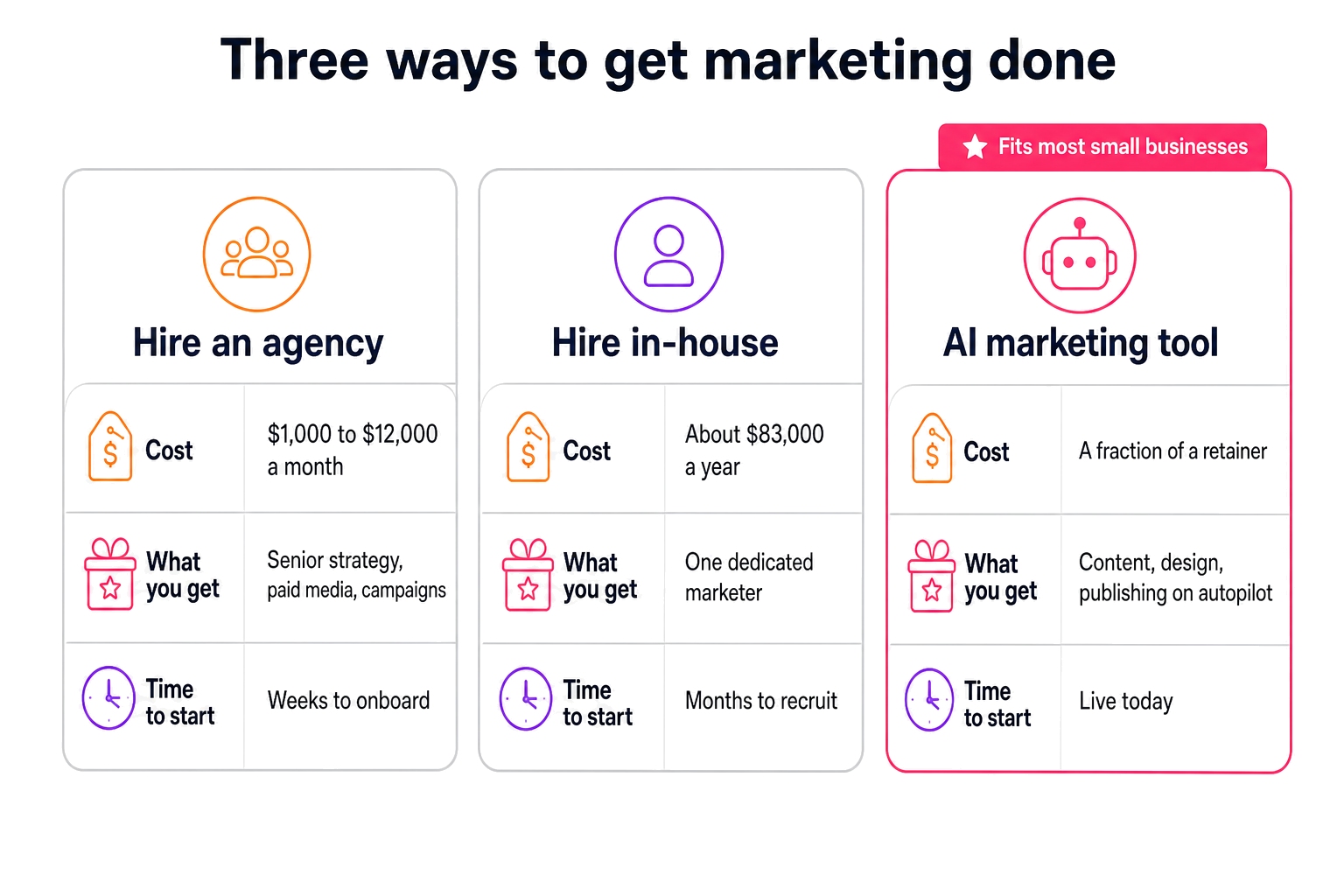
The going rate is higher than most owners expect. In WebFX's 2026 survey of over 1,000 U.S. businesses, typical agency retainers run from $1,000 to $12,000 a month, with focused small-business engagements, one or two channels such as SEO plus content, starting near the lower end. Onboarding usually adds a few weeks before the first work ships.
Hold that against what small businesses actually spend. In LocaliQ's 2026 small-business marketing report, 52% of small businesses report a total monthly marketing budget under $1,000, below the entry price of most retainers, and half have no employee dedicated to marketing at all. For the median small business, the standard agency product is out of reach before the conversation starts.
Hiring instead of contracting does not close the gap. The average U.S. marketing manager earns about $83,000 a year before benefits, and that buys one person, not a strategist plus a designer plus a media buyer, and recruiting takes months. So the real decision for most owners is not agency versus employee. It is agency versus software plus their own judgment.
What an agency is genuinely better at
An agency is the right call when the work needs senior specialists and many coordinated hands: managing a serious advertising budget, planning a repositioning or a launch, producing campaign-level creative. Those are judgment-heavy, high-stakes projects, and a good agency brings a bench of experience that no tool replaces.
The economics can genuinely work. Paid media is the clearest case: when a business spends five figures a month on ads, a management fee that prevents even a modest share of wasted spend pays for itself, and an experienced buyer routinely does. The same logic covers a launch where the positioning decision is worth more than the retainer. Where agencies fail small businesses is when that machinery is sold to a business whose actual need is a steady, on-brand presence, work that does not need a bench. It needs consistency.
What an AI marketing tool covers now
The day-to-day content operation, deciding what to post, writing it, designing it to a brand system, scheduling it, and publishing it across channels, is now handled end to end by software. That work used to fill most of a small-business retainer, and it is exactly the work AI marketing tools automate first.
Small businesses have already moved. In the same LocaliQ report, 81% of small businesses now use AI for content creation, up from 52% a year earlier, while the share working with outside marketing partners fell from 60% to 34% in a single year. The shift from buying hours to buying software is not a prediction. It is already in the data.
Marvin is a worked example of the category. It learns how a business looks and sounds once, then creates and publishes on-brand posts, carousels, and video on autopilot across Instagram, Facebook, and LinkedIn on a schedule the owner sets. The owner's job contracts to the two things software should not decide: what the business promises, and the final yes.
How to decide
The decision reduces to three questions: what is the monthly budget, is paid advertising a core channel, and who has time to own the output. Under roughly $1,000 a month, a tool is the only option that buys a full content operation. With heavy ad spend, pair a specialist with a tool. In between, compare coverage per dollar.
A useful test is to write down what the business actually needs each month. If the list reads "show up consistently, look professional, sound like us, post without being reminded," that is a production problem, and production is what software now does better per dollar. If the list reads "settle our positioning, run a five-figure ad budget, produce a campaign," that is a judgment problem, and judgment is what retainers are for.
The middle path is common and reasonable: run the everyday engine on software, and buy specialist hours only when a project genuinely needs them. Starting with the tool carries little risk, Marvin's pricing is built for a business of one, so the downside of trying it first is a month, not a contract.
For most small businesses the sequencing matters more than the label: get a consistent, on-brand engine running first, because every other marketing decision assumes it exists. The economics behind that engine changed when premium marketing stopped costing a fortune, and the setup itself is covered step by step in the AI marketing automation guide. For what that looks like in practice, one business built its whole marketing kit this way in about half an hour. If the software decision is already made and the question is which tool, what these platforms actually cost per user is the next thing to check.
Frequently asked
- How much does a marketing agency cost for a small business?
- Surveys in 2026 put typical retainers between $1,000 and $12,000 a month, with focused one-or-two-channel engagements at the lower end. Most small businesses sit below that line entirely: about half report total monthly marketing budgets under $1,000, so the standard retainer is priced above the median budget.
- Can an AI marketing tool replace a marketing agency?
- For the day-to-day operation, planning, writing, design, scheduling, and publishing, yes for most small businesses. It does not replace senior strategy for complex paid campaigns or a high-stakes launch. Many businesses run the everyday engine on software and bring in a specialist only when a project needs one.
- When is hiring a marketing agency worth it?
- When ad spend is large enough that expert management pays for itself, when a launch or repositioning carries real strategic risk, or when there is budget of several thousand a month and genuinely nobody to own marketing. Below that, a retainer buys less output per dollar than a tool plus a few owner hours a week.
- What does an AI marketing tool cost compared to an agency?
- Tools are subscription software priced for small businesses, while agency retainers start around $1,000 a month and onboarding takes weeks. A tool is live the same day, so the practical difference is not only price but commitment: trying a tool costs a month, not a contract.