AI marketing automation: a small business guide
 The Marvin Team, Content & Growth·Jul 9, 2026
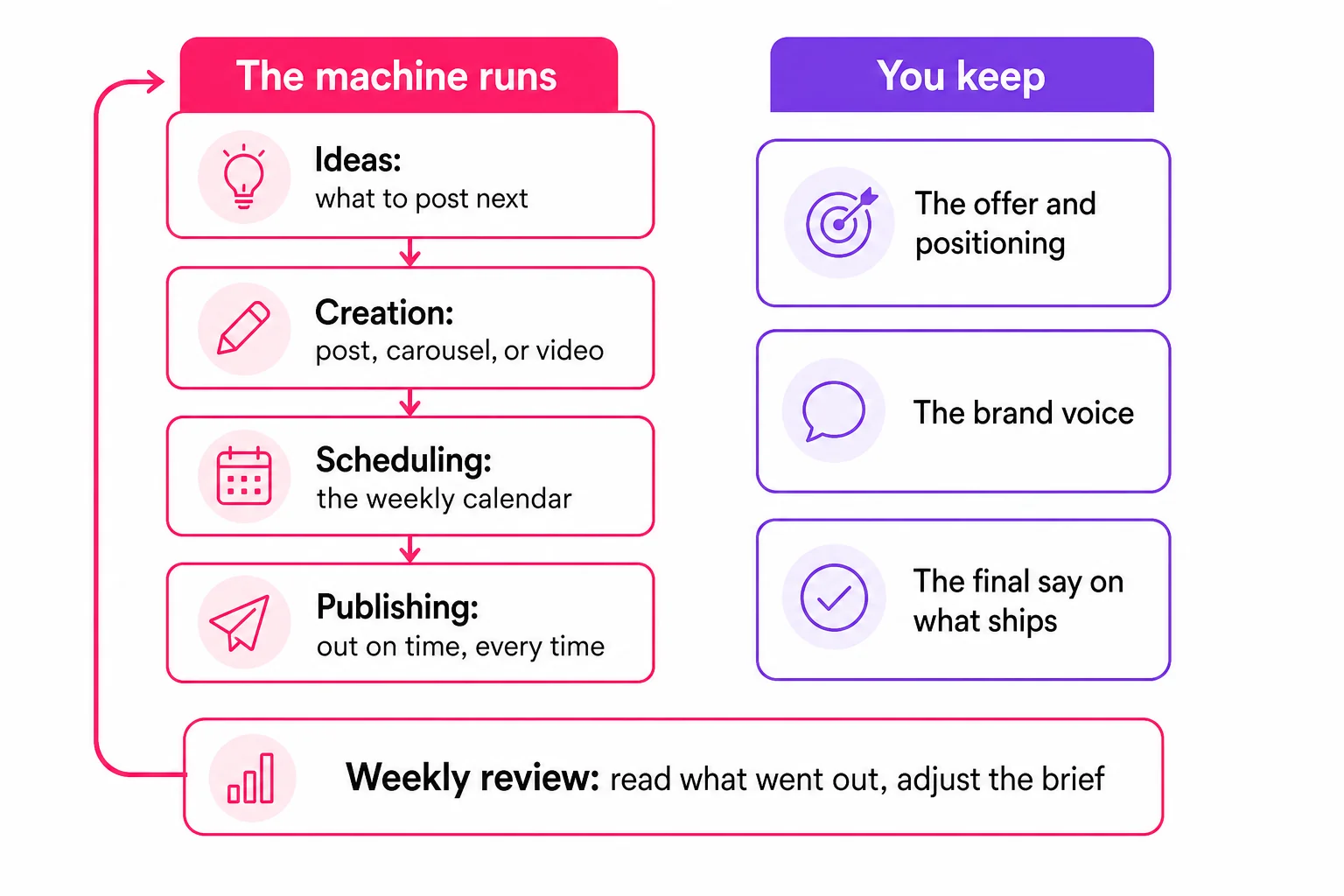
AI marketing automation is software that runs the whole content loop for you: it decides what to post next, creates the post, schedules it, and publishes it on a cadence you set. This guide covers what it can honestly take off your plate, how to set it up step by step, and what you should keep for yourself.
What AI marketing automation actually is
For most of its life, marketing automation meant moving finished pieces around: a tool sent the email you wrote, posted the graphic you designed, fired the rule you configured. AI marketing automation is the new layer on top of that. The machine now makes the thing as well as ships it, writing the post, building the carousel, adapting one idea to each channel, and then publishing it all on schedule.
The old kind already paid for itself. Nucleus Research put the return on marketing automation at $5.44 for every dollar spent over three years, and that was before the software could create anything. Before Marvin, our team spent years running marketing for large brands, and automation was the quiet backbone of every program, but creation still needed a room of specialists: a writer, a designer, someone reshaping everything for each channel. The AI layer is what finally automates that room.
Why small businesses feel it most
A big company feels AI automation as a productivity gain. A small business feels it as the difference between showing up and going quiet, because the first thing a busy week kills is the content calendar. And the hours involved are not small: in a 2025 survey of 1,000 marketers commissioned by ActiveCampaign, teams using AI reported saving around 13 hours per person per week and cutting operating costs by roughly $4,700 a month. For a team of one, 13 hours a week is not a rounding error. It is the marketing job itself.
It is also no longer a fringe practice you can wait out. HubSpot's research counts 66% of marketers globally already using AI in their roles. The tools are table stakes now, so the edge has moved to how deliberately you set them up. Which is the part you control.
How to automate your social media posts, step by step
Automating your social media posts comes down to four decisions, made once: what the machine needs to know about your business, which channel and format to start with, what cadence to run, and when you will review the output. Everything after that is letting it run long enough to judge it fairly.
First, write the brief. Before any tool touches your marketing, put the essentials in one place: what you sell, who it is for, how you talk, and what you would never say. Every automation is only as good as the context behind it, and skipping this step is how businesses end up publishing the same generic content as everyone else.
Second, start with one channel and one format. Pick the place your customers actually are and a format you can sustain, a weekly carousel on Instagram, three short posts on LinkedIn, and automate only that. One automation you trust beats five you have to babysit.
Third, set a cadence you could keep on your worst week, then let the machine hold it. Consistency is the entire point of automation, the engine that makes every other marketing job possible. If the cadence only survives your best week, it is set too high.
Fourth, expand one automation at a time. Once the first has run for a few weeks and still sounds like you, add the next channel or format. The spread is worth it: Omnisend analyzed 135,000 campaigns and found marketers running three or more channels earned a 494% higher order rate than those on one. But add channels the way you would hire, one at a time, checking the work.
What not to automate
Three things stay yours: the offer, the voice, and the judgment. What you sell and to whom is strategy, and no machine should set it. How you sound has to be defined by you before software can hold you to it. And the final say on what ships stays human, because you are the one your customers trust.
This is the line we watched big brands get right and small businesses get wrong in both directions. Some automate nothing and burn out. Some automate everything, including the thinking, and their marketing turns into wallpaper. The machine is a production team, not a founder. Hand it the loop, keep the wheel.
How to tell it is working
Review weekly, judge monthly. Once a week, read what went out and ask three questions: did it ship on schedule, does it sound like us, and did anyone act on it, a follow, a reply, a click, a message. When an answer is no, fix the brief, not the individual post, because patching posts by hand puts you right back in the production seat you just left.
Then give the numbers time. Content compounds slowly, and a fair verdict on an automation needs weeks of consistent output, not days. The most common failure we see is switching everything off in week two, right before the curve starts to move.
Where Marvin fits
Everything above is tool-agnostic, and you can assemble it from parts. We built Marvin so you do not have to. You set your business and brand up once, then create automations that each pick a channel, a topic, a format, and a schedule, and Marvin creates and publishes on its own from there. When we opened up unlimited automations earlier this year, the pattern in this guide, one automation first, then one more at a time, is exactly how we watched people succeed with it.
If the economics are the question, the pricing is built for a business of one, not a marketing department. And if the alternative you are weighing is outside help, the comparison with hiring an agency puts the numbers side by side. Start with a single automation on the channel that matters most, hold the weekly review, and let the machine do the showing up.
Frequently asked
- What is AI marketing automation?
- Software that runs the content loop end to end: choosing what to post next, creating the post, scheduling it, and publishing it on a set cadence. It differs from classic automation, which only moved finished pieces around. You supply the strategy, the brand, and the review; the machine supplies the production.
- What should a small business automate first?
- One channel, one format, on a cadence you could keep in your worst week. Write the brief first, what you sell, who it is for, how you sound, then let a single automation run for a few weeks before judging it or adding another. One automation you trust beats five you babysit.
- Will automated marketing sound generic?
- Only if the machine has nothing to work with. Raw AI output drifts toward the same flat voice for everyone, so an automation needs your brand context behind it, your offer, audience, tone, and examples. Set that up once, and hold the output to it in a weekly review.
- How much time does AI marketing automation save?
- Recent surveys put it at hours per week, not minutes. A 2025 ActiveCampaign study of 1,000 marketers found around 13 hours saved per person per week, and HubSpot reports one to two hours a day on generative tasks alone. For a small business, that is the difference between marketing happening and not.