6 Hootsuite alternatives for small businesses in 2026
 The Marvin Team, Content & Growth·Aug 3, 2026
Hootsuite publishes its paid plans at $99 a month for Standard, $199 for Professional, and $399 for Advanced, each charged per user. The six alternatives below are Buffer, Metricool, SocialBee, Later, Sprout Social, and Marvin. They are not interchangeable, and the right one depends on whether the harder job is scheduling posts or producing them.
What Hootsuite costs in 2026
Hootsuite lists three self-serve tiers plus a quoted Enterprise plan. According to Hootsuite's own plans page, Standard is $99 per user per month and covers 10 social accounts, Professional is $199 per user per month with unlimited accounts, and Advanced is $399 per user per month. Enterprise is priced on request. Every tier is billed per user, which is the detail that decides what a small business actually pays.
The arithmetic is worth doing before comparing feature lists. One owner on Professional pays $199 a month, or $2,388 a year. Add a part-time helper who needs their own login and the same plan costs $398 a month, or $4,776 a year, with no additional capability. The plan did not change. The headcount did.
The pricing model matters more than the sticker price
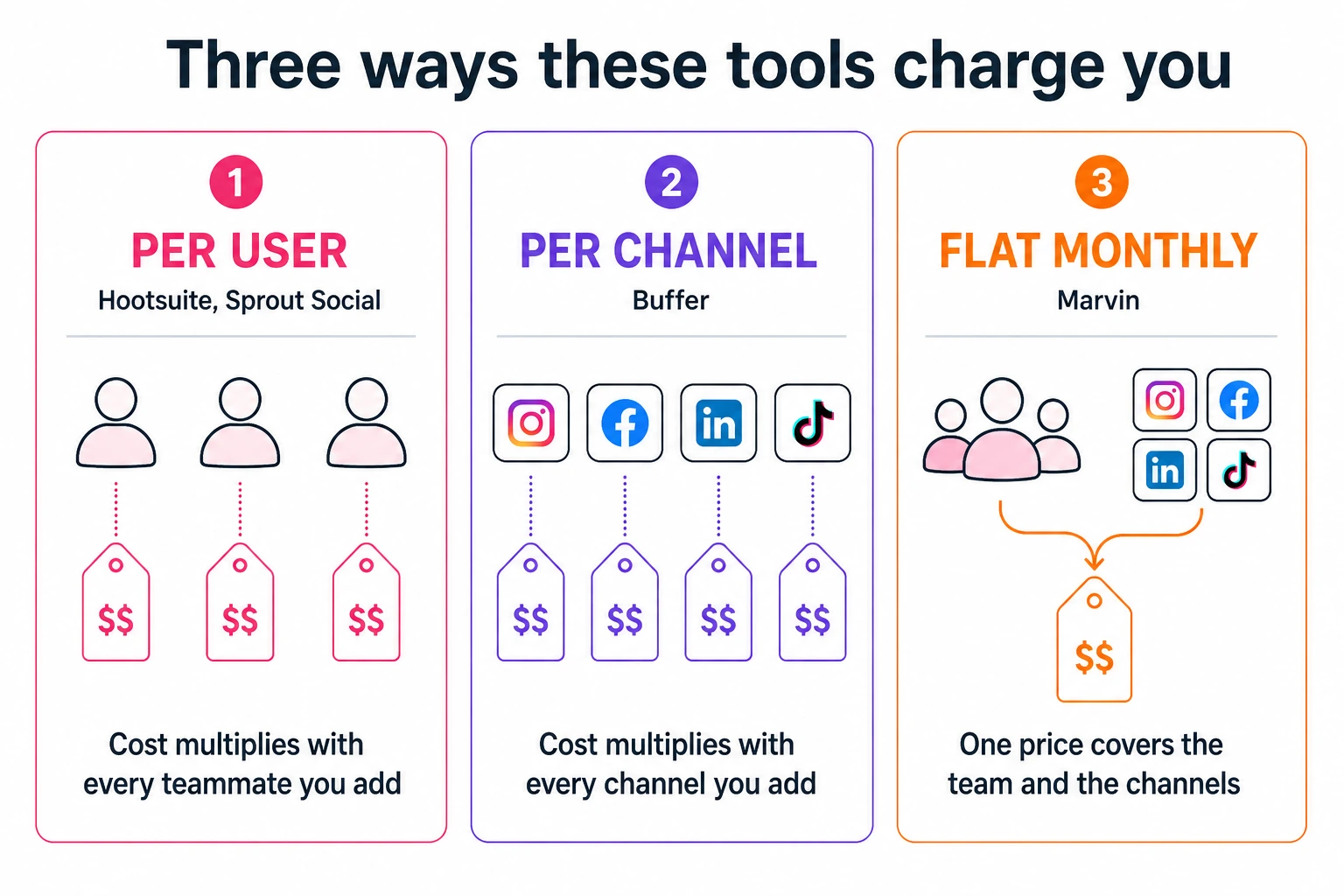
Social media tools charge in one of three ways, and each punishes a different kind of growth. Per-user pricing gets more expensive as the team grows. Per-channel pricing gets more expensive as the brand adds platforms. Flat pricing holds steady on both. Comparing monthly headline figures without checking which model is in play is how a plan that looked affordable in month one becomes the second-largest line in the marketing budget by month six.
The six tools below split across all three models. Sprout Social bills per seat like Hootsuite, so it costs more as the team grows. Buffer charges per channel, so it costs more as the brand adds platforms. Metricool scales by the number of brands connected. SocialBee, Later, and Marvin charge a flat monthly rate. Two plans with the same headline price can diverge sharply within a year on nothing but which of those a business happens to be adding.
Context for those numbers: in LocaliQ's 2026 small-business marketing report, 52% of small businesses run a total monthly marketing budget under $1,000. A $199 per-user plan is a fifth of that budget for one seat, before anything has been created to put in it.
1. Buffer, for the cheapest straight swap
Buffer is the closest thing to a like-for-like scheduler at a much lower price, and it charges per channel rather than per user. Its published pricing is a free plan for up to 3 channels with 10 scheduled posts each, $5 per channel per month on Essentials, and $10 per channel per month on Team. Four channels on Team is $40 a month no matter how many people log in.
Best for a small business that already knows what it wants to post and simply needs it queued across a handful of channels. The trade-off is depth: analytics are lighter than Hootsuite's and there is no serious social listening.
2. Metricool, for reporting on a free tier
Metricool leans harder on analytics than most tools at its price. Its plans start with a free tier covering 1 brand, then Starter from $20 a month for 5 brands and Advanced from $53 a month for 15 brands. Pricing scales by the number of brands connected rather than by seats, so adding a teammate does not change the bill.
Best for an owner or a small agency who wants competitor tracking and reporting without a per-seat suite price. Someone managing a single brand may find the free tier covers more than expected.
3. SocialBee, for flat-rate posting with content categories
SocialBee prices flat by profile count instead of per user. Its published plans are Bootstrap at $29 a month for 5 social profiles and 1 user, Accelerate at $49 a month for 10 profiles, and Pro at $99 a month for 25 profiles and 3 users, on monthly billing. Its distinguishing feature is category-based queues, where posts are grouped by theme and recycled on a schedule.
Best for a business with a library of evergreen content it wants to rotate rather than write fresh every week. Less suited to a brand whose posts are mostly timely.
4. Later, for visual planning across profile sets
Later bundles profiles into what it calls social sets. Its pricing page lists Starter at $18.75 a month for 1 social set of 8 profiles, Growth at $37.50 a month for 2 sets and 2 users, and Scale at $82.50 a month for 6 sets and 4 users, with those rates billed yearly and monthly billing costing more. Extra users are $3.75 a month each.
Best for visual-first brands planning an Instagram or TikTok grid, where seeing the feed laid out before it publishes is worth more than inbox management. Note that the headline prices assume an annual commitment.
5. Sprout Social, if the full suite is what is needed
Sprout Social is the closest competitor to Hootsuite in capability, and it is not a way to spend less. Its pricing runs per seat from $99 a month on Essentials billed monthly, through $199 Standard and $299 Professional, to $399 on Advanced. That is the same $99 to $399 band Hootsuite occupies, on the same per-seat model.
Best for a team that genuinely needs listening, a shared inbox, and reporting, and wants a different interface or support experience. Choosing it is a feature decision, not a cost saving, and it should be made on that basis.
6. Marvin, if the problem is producing the posts
Every tool above assumes the posts already exist. A scheduler is a queue: it takes finished captions and finished images and publishes them on time. Marvin is built for the other job. It learns how a business looks and sounds once, then creates and publishes on-brand content across Instagram, Facebook, TikTok, and LinkedIn on a set schedule. Its plans are flat monthly, starting at $49 and covering all channels at every tier.
Best for an owner whose calendar is empty because nobody has time to write and design the posts. To be straight about the trade-off: Marvin does not offer social listening or a unified inbox, so a business that needs those should keep a tool that has them.
Who should stay on Hootsuite
Hootsuite earns its price for a specific kind of team, and switching away from it is a mistake for that team. It is strong on social listening across a brand's mentions, a unified inbox for handling replies at volume, approval workflows where posts need a second signature before going out, and reporting built for people who present numbers to someone else.
The pattern is that Hootsuite is priced for coordination. If several people touch the same accounts, if inbound messages are a real workload, or if a compliance step sits between drafting and publishing, that is what the per-user fee buys and it is reasonable. Businesses in that position should stay put.
The question that decides it: scheduling or producing
For most small businesses the empty calendar is the real problem, not the publishing mechanics. A cheaper queue makes an unused subscription cheaper. It does not make the posts appear. Anyone comparing the six options above should first work out which of the two jobs is actually going unfinished, because the answer points at different products.
How to choose
Three questions settle it. First, how many people need their own login, because that single answer can double or triple the cost of any per-seat tool. Second, is handling inbound messages and mentions a real part of the week, because that is what the expensive suites are for. Third, and most important, is the recurring problem publishing the content or producing it.
If the answers are one person, no serious inbox load, and an empty calendar, a cheaper scheduler is the wrong fix and a content tool is the right one. If they are several people, a busy inbox, and a full calendar, Hootsuite is already the correct purchase. The upstream version of this decision, whether to buy software at all or hire it out, is covered in the comparison of AI marketing tools and agencies, and one business's full brand kit built in about half an hour shows what produced-not-scheduled looks like in practice.
Frequently asked
- Is there a free alternative to Hootsuite?
- Two of the six have free tiers. Buffer's covers up to 3 channels with 10 scheduled posts per channel and one user. Metricool's covers 1 brand and includes its analytics. Both handle basic queueing, and neither offers social listening or a unified inbox, so they suit a solo business rather than a team.
- Why does Hootsuite get more expensive as a team grows?
- Every Hootsuite tier is billed per user, so the monthly cost multiplies with each person who needs their own login. Two people on the $199 Professional plan pay $398 a month for the same features one person gets for $199. Per-channel and flat-rate tools do not scale this way.
- Which is cheaper, Hootsuite or Sprout Social?
- Neither is meaningfully cheaper. Both bill per seat across the same $99 to $399 per month band: Hootsuite lists three tiers at $99, $199, and $399, and Sprout Social lists four at $99 billed monthly, $199, $299, and $399. Switching between them is a feature decision, not a cost saving.
- Should a small business switch away from Hootsuite?
- Only if the features being paid for are going unused. A business with one or two logins, little inbound message volume, and a struggle to produce posts is paying for coordination it does not need. A business with several users, a busy inbox, and approval steps is buying exactly the right thing.
- What is the cheapest Hootsuite alternative?
- On published list prices, Buffer is cheapest for a small channel count at $5 per channel per month, and both Buffer and Metricool offer free tiers. Cheapest is not the same as right: if the recurring problem is that nobody has written the week's posts, a cheaper queue does not solve it.